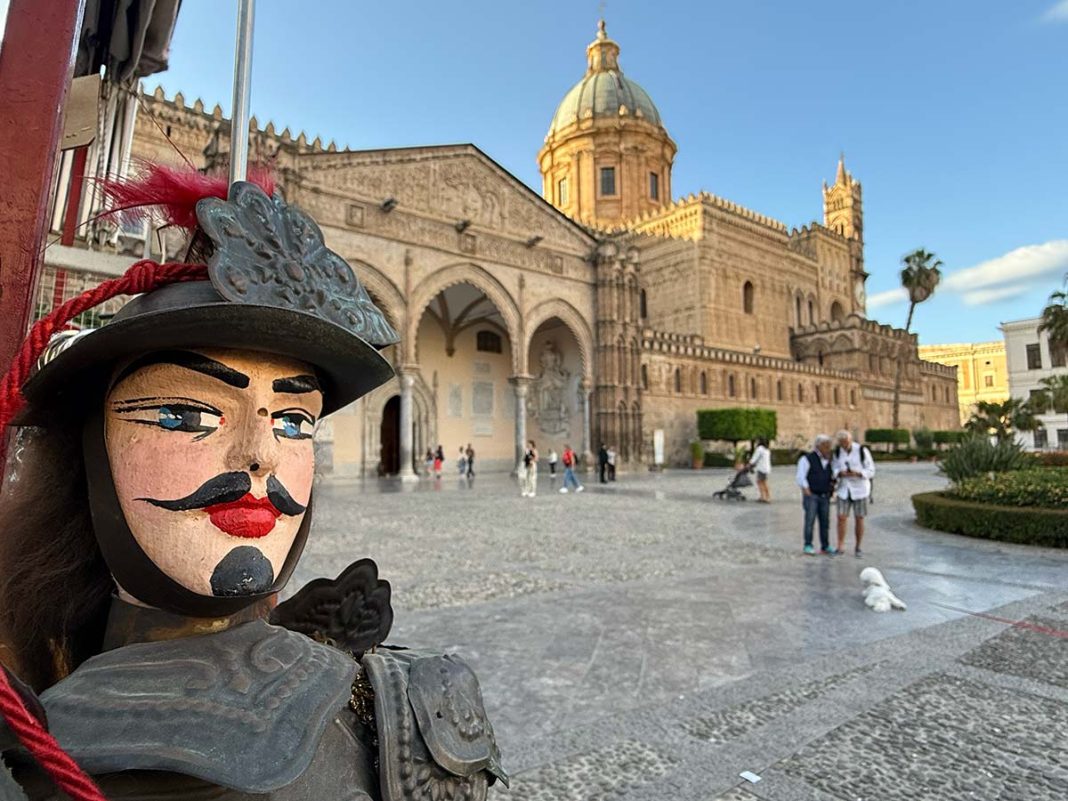
What to see in Palermo in one day? It’s an incredibly difficult question—almost impossible to answer. Palermo is a rich and layered city, full of churches, markets, palaces, scents, and irresistible food. But when time is limited, you have to make choices.
In this 24-hour itinerary in Palermo, we decided to explore on foot and focus on the historic center. Our route includes a market, a church, an iconic square, a few detours, and plenty of food breaks.
Because in Palermo you walk a lot—but you also eat very well. A granita, a cannolo, or an arancina quickly becomes part of the journey.
This is our walking itinerary to see Palermo in one day, tested in person among historic markets, must-see monuments, and unforgettable Sicilian flavors.
Palermo in on day: walking itinerary
If you only have 24 hours, here are the essential stops from our walking tour of Palermo’s historic center. Below you’ll find the full story, including tips, costs, and what to eat along the way.
- Ballarò Market (street food lunch)
- Via Maqueda and Quattro Canti
- Piazza Bellini: Martorana / San Cataldo + Santa Caterina (including rooftop and cloister)
- Fontana della Vergogna (Piazza Pretoria)
- Palermo Cathedral (even just the exterior if you’re short on time)
- Teatro Massimo (scenic stop)
- Piazza San Domenico and Vucciria
- Piazza Marina
- Palermo Botanical Garden (a green and refreshing finale)
Tip: If time is extremely tight, choose one market (Ballarò or Vucciria) and one church (we chose Santa Caterina).
If you’re looking for an even more family-focused route, read our guide to Palermo with kids and the best things to see in Palermo with children.
How to Get to Palermo
If you only have one day in Palermo, the easiest way to reach the city center is to fly and then use public transportation.
We arrived from Turin with a direct Ryanair flight (about 1 hour and 20 minutes). From the airport we took the train to Palermo Centrale Station.
Trains leave roughly every 30 minutes. The ticket costs €6.80, and the journey takes about an hour. Considering Palermo’s traffic, this is usually more convenient and cheaper than a taxi—especially if, like us, you’re staying only 24 hours and traveling light.
Walking Itinerary in Palermo’s Historic Center
Our walking itinerary to see Palermo in one day starts here.
After arriving in the city, we chose to explore the historic center on foot. We followed a logical route with no rush, moving between markets, squares, churches, and delicious food stops.
The stops below are arranged so they can be done consecutively in 24 hours, with short detours and plenty of opportunities to pause, observe, and eat.
If you have less time, you can select only a few stops. If you have more time, simply extend the visits.
Ballarò Market: Street Food Lunch Stop
Our day in Palermo truly begins here—with lunch at Ballarò Market, one of the most authentic stops to include in a one-day itinerary.
Our apartment was near Teatro Massimo, but we simply set the GPS and quickly reached Ballarò just a few steps from the Central Station.
The access street is small and a bit unexpected (we couldn’t find the entrance at first), but we loved the large spaces, spacious bathrooms, and central location.
Alternatively, you can search for the best hotel and apartment deals in Palermo on Booking.
It’s 1 p.m., and at that hour it’s impossible not to stop at Ballarò. We followed the sounds, the voices, and the smells of the market.
Is it touristy? Yes. But it’s also vibrant, authentic, and overwhelming in the best way.
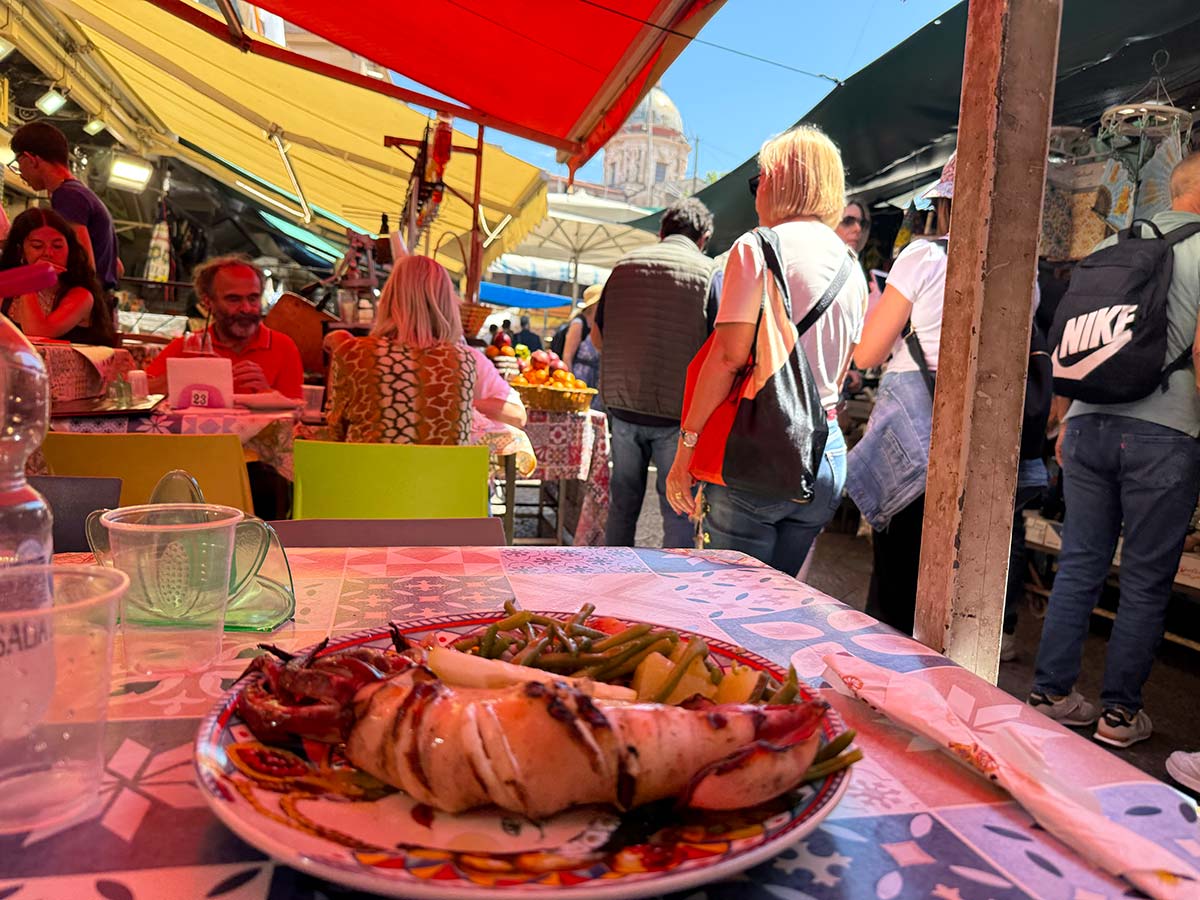
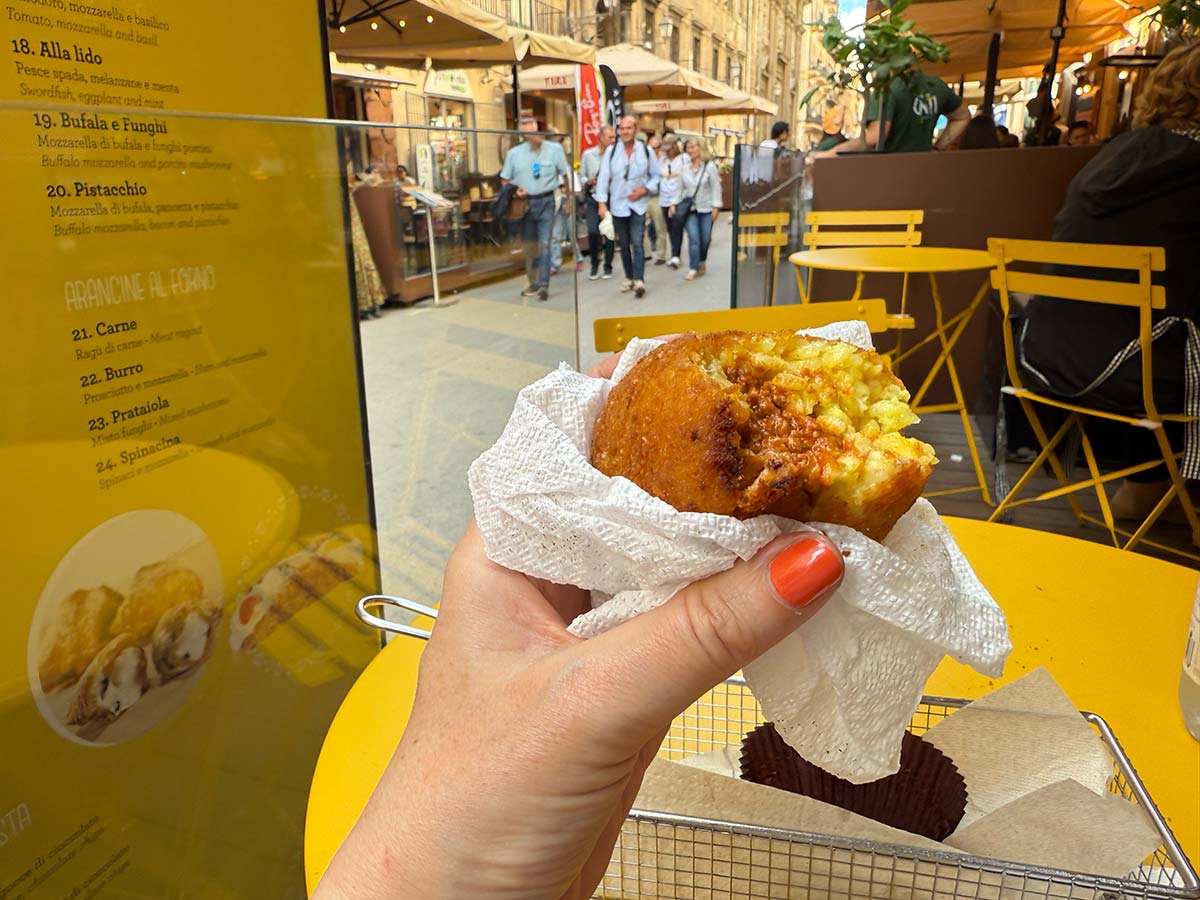
Panelle, fried eggplant, and freshly fried arancine tempt you at every stall. In the end we gave in and sat down to eat.
We were craving fresh seafood: squid, tuna, and swordfish. We didn’t check reviews—just followed our instincts.
We ate very well: €12 per person for a main dish, a side, and a drink.
Full and happy, we continued walking. From Ballarò onward, our Palermo historic center itinerary really comes alive.
Via Maqueda: Walking Through the Heart of Palermo
After lunch at Ballarò, we reached Via Maqueda, one of the most important streets in Palermo’s historic center.
It’s a lively pedestrian street, perfect for walking during a one-day itinerary.
Via Maqueda dates back to the 16th century. Spanish viceroys designed it as a straight axis connecting the city’s main centers of power.
Today it’s the heart of everyday Palermo, lined with historic buildings, shops, cafés, and street food stands.
A friend from Palermo recommended them to us: try the meat or butter version
Quattro Canti: The Center of Historic Palermo
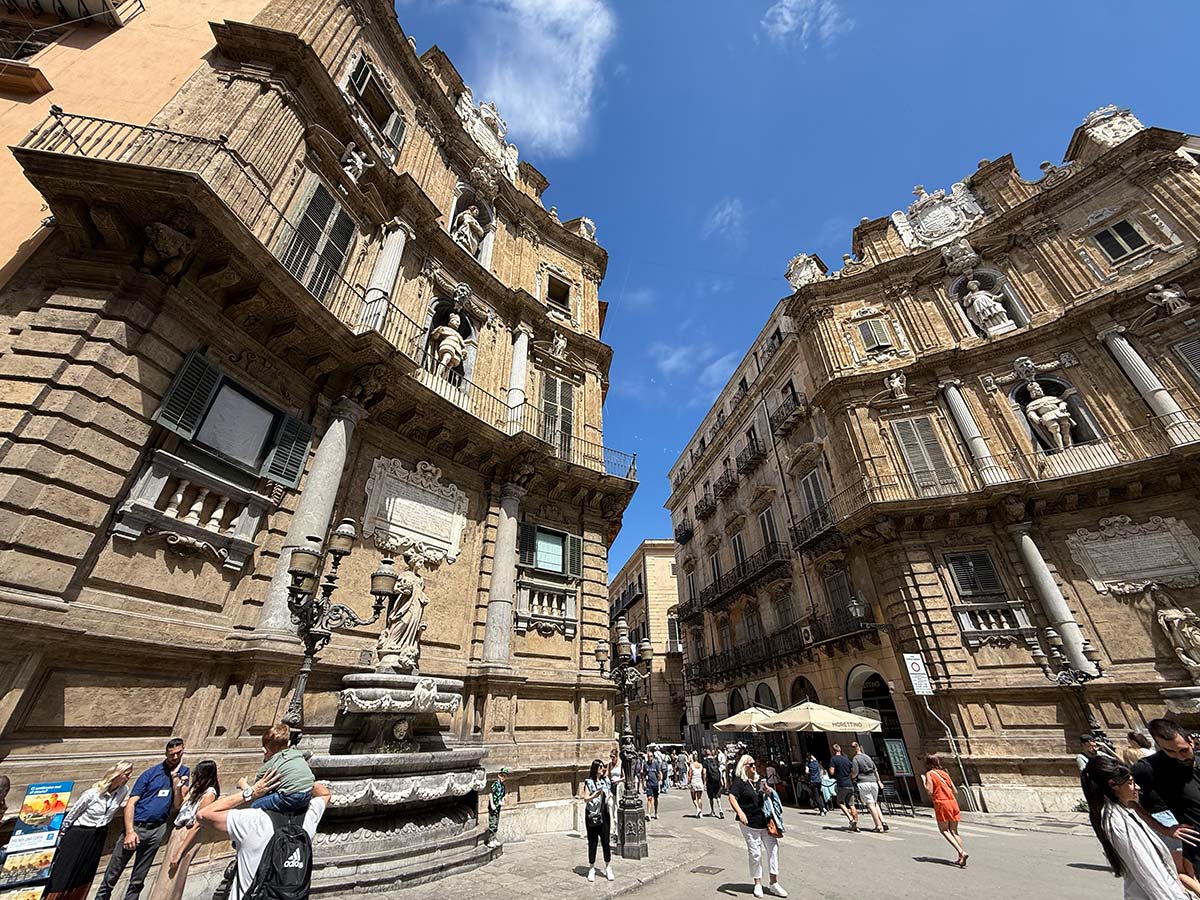
Continuing along Via Maqueda, you reach Quattro Canti, a perfectly symmetrical octagonal square where Via Maqueda intersects with Corso Vittorio Emanuele. It’s considered the exact center of historic Palermo and is a must-see stop in any one-day itinerary.
Each façade represents a season, a king, and a patron saint, creating a unique theatrical effect.
Quattro Canti is one of the most photographed places in the city. It’s always lively and full of energy.
When we passed by, a man was singing loudly while a few tourists danced in the street.
It’s very touristy—but surprisingly relaxing. Definitely one of the highlights of what to see in Palermo in one day.
Piazza Bellini: Three Monumental Churches in One Square
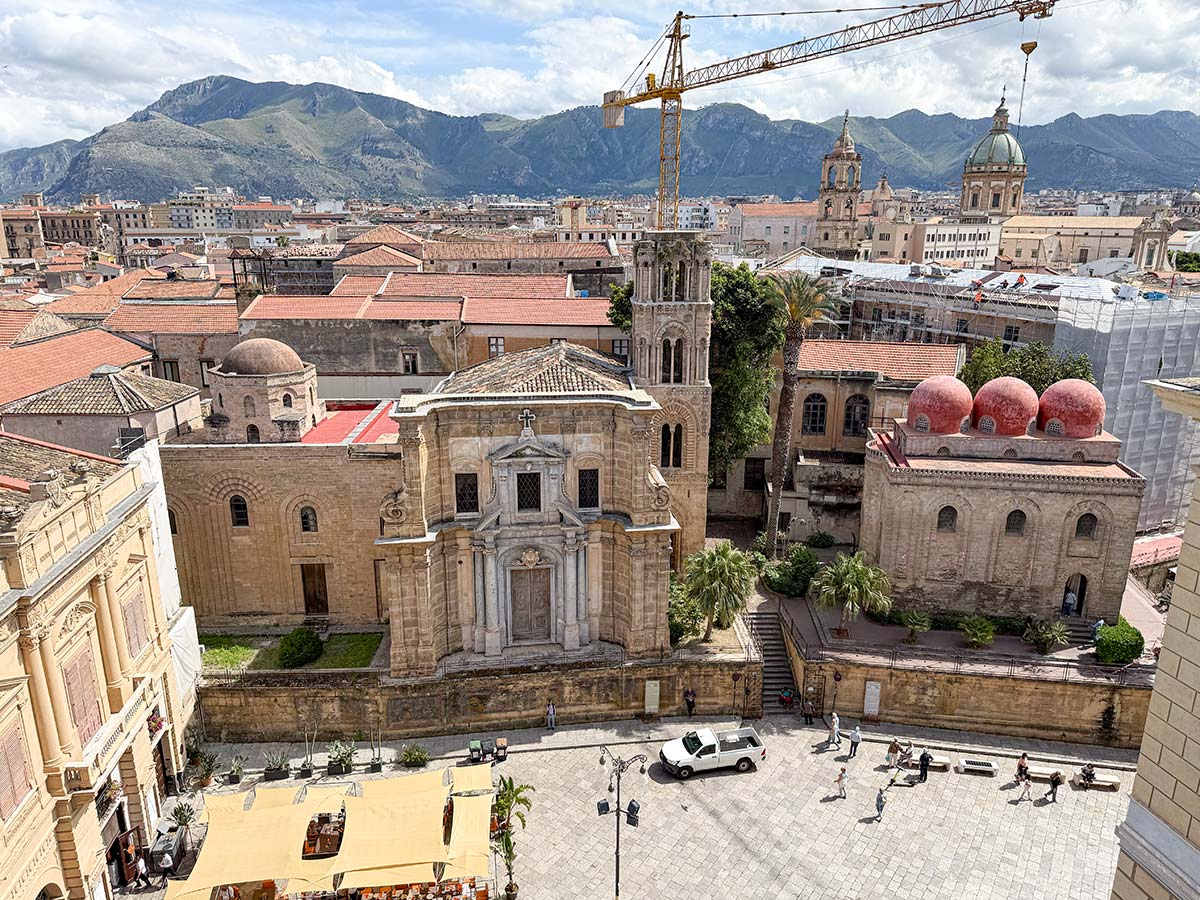
From Quattro Canti you can easily reach Piazza Bellini, a small and surprising square where three monumental churches stand within just a few steps of each other.
We wanted to visit La Martorana, famous for its 12th-century Byzantine mosaics, but it’s only open in the morning (usually 9:00 a.m.–1:00 p.m., entrance €2).
Besides Martorana, the square also hosts San Cataldo, recognizable for its three red domes in Arab-Norman style, and Santa Caterina.
This is one of the places where you truly feel Palermo’s complex history.
San Cataldo, built in the 12th century, is part of the Arab-Norman Palermo UNESCO World Heritage site. Its interior is simple and austere, in sharp contrast with Martorana’s rich decorations.
In just a few steps, you encounter Arab, Byzantine, and Norman influences. That only happens in Palermo.
In the end, we chose to visit Santa Caterina—and we didn’t regret it.
Santa Caterina: Palermo’s Most Surprising Church
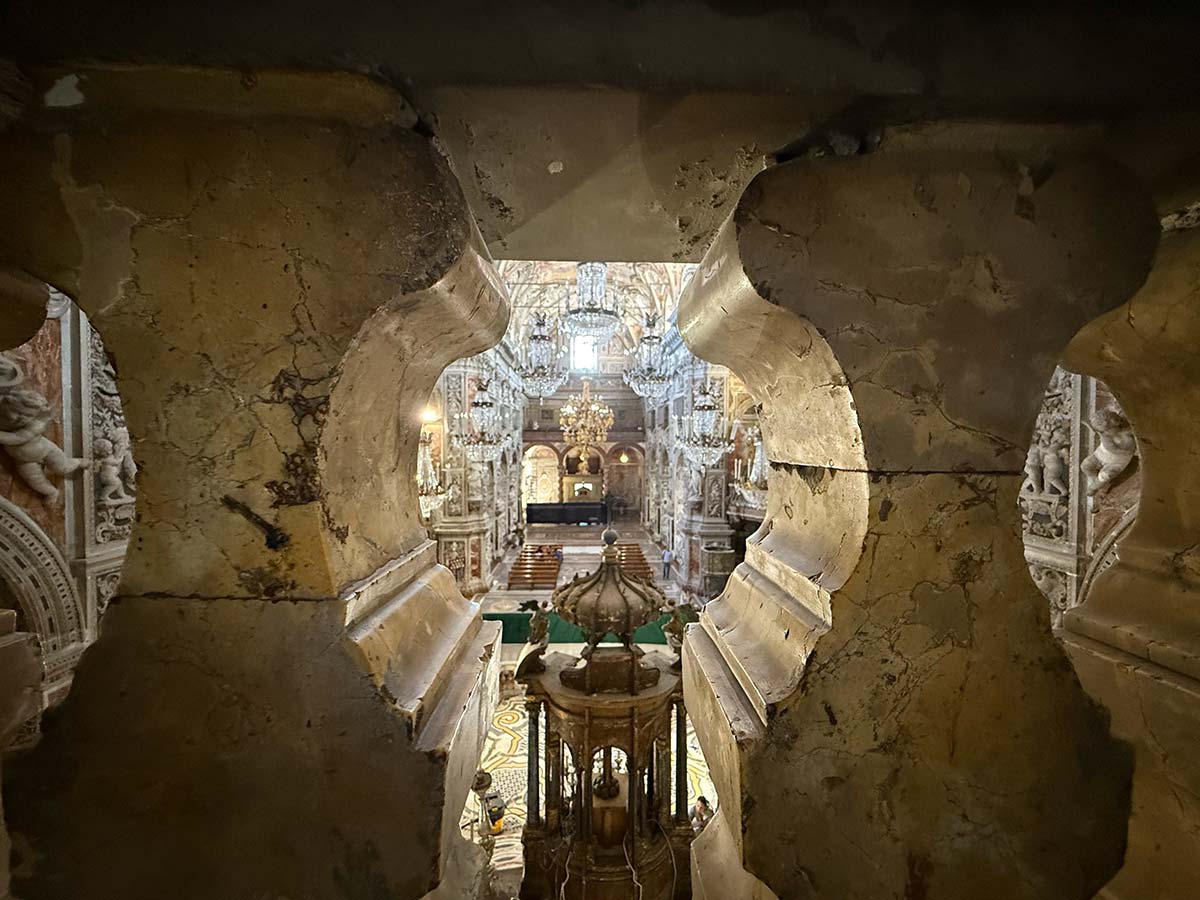
We arrived at our favorite stop among what to see in Palermo in one day: the Church of Santa Caterina d’Alessandria, overlooking Piazza Bellini.
For a long time it remained overshadowed by Martorana and San Cataldo, but it’s actually one of the most spectacular churches in the city.
It was built at the end of the 16th century as part of a Dominican cloistered convent. The nuns lived in silence, prayed, and worked without ever leaving the monastery.
But they had a special talent: cooking.
The interior is a triumph of Sicilian Baroque. Stucco, frescoes, colored marble, and decorations cover almost every surface.
You’ll notice illusionistic paintings, clever perspective effects, and light that changes throughout the day.
The church is impressive at first glance—but the real secret is to go up.
With the full ticket (€10), you can access the rooftops. The path winds through narrow staircases and panoramic balconies. It’s safe even with kids, but not ideal if you suffer from vertigo.
From above, you can see all of Palermo: domes, markets, and the sea.
- Indicative hours: daily from 10:00 a.m. to 6:00 p.m. (last entry 5:30 p.m.)
The Cloister and the Nuns’ Pastry Shop
After visiting the church and the rooftops, the route ends in the monastery cloister.
It’s a quiet and cool space with a central garden and stone arches.
Today the cloister hosts the Dolceria del Convento, where desserts are prepared using ancient recipes created by the cloistered nuns.
What you can find:
- Minne di Sant’Agata
- Cannoli with fresh ricotta
- Cassata, almond cookies, and traditional sweets
Each dessert is linked to a religious celebration. In the past, they were sold behind iron grates so the nuns could not be seen.
Today young pastry chefs continue the tradition.
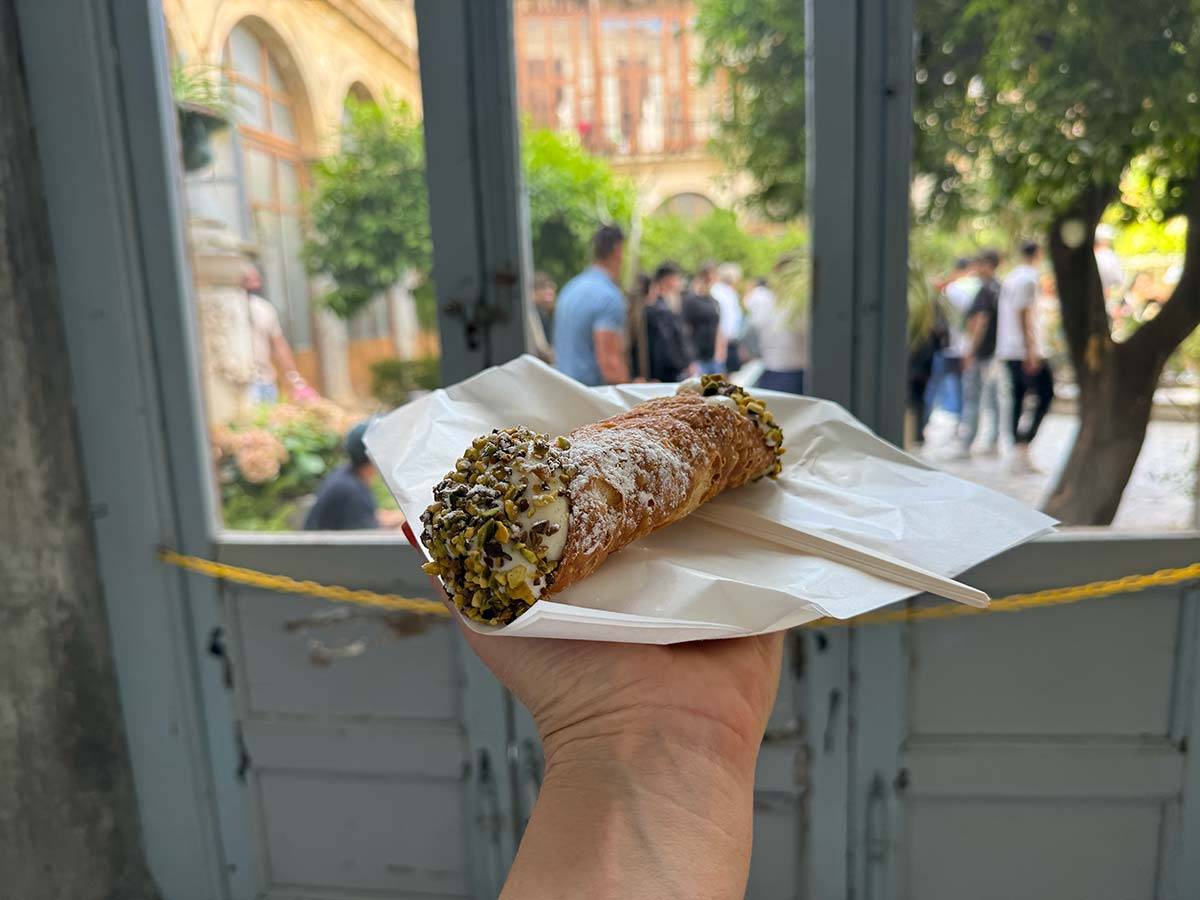
Sitting in the cloister with a tray of sweets, listening to the fountain, and watching the light filter through the columns is one of those unforgettable travel moments.
The nuns prepared the desserts in silence and passed them through a rotating wheel so no one could see them.
Even the rooftop path hides surprises: small doors suddenly open onto new views of Palermo.
Fontana della Vergogna: Piazza Pretoria
A few steps from Piazza Bellini lies Piazza Pretoria, dominated by the large Fontana della Vergogna.
The fountain was created in Florence in 1554 for a private palace and later transferred to Palermo in 1573.
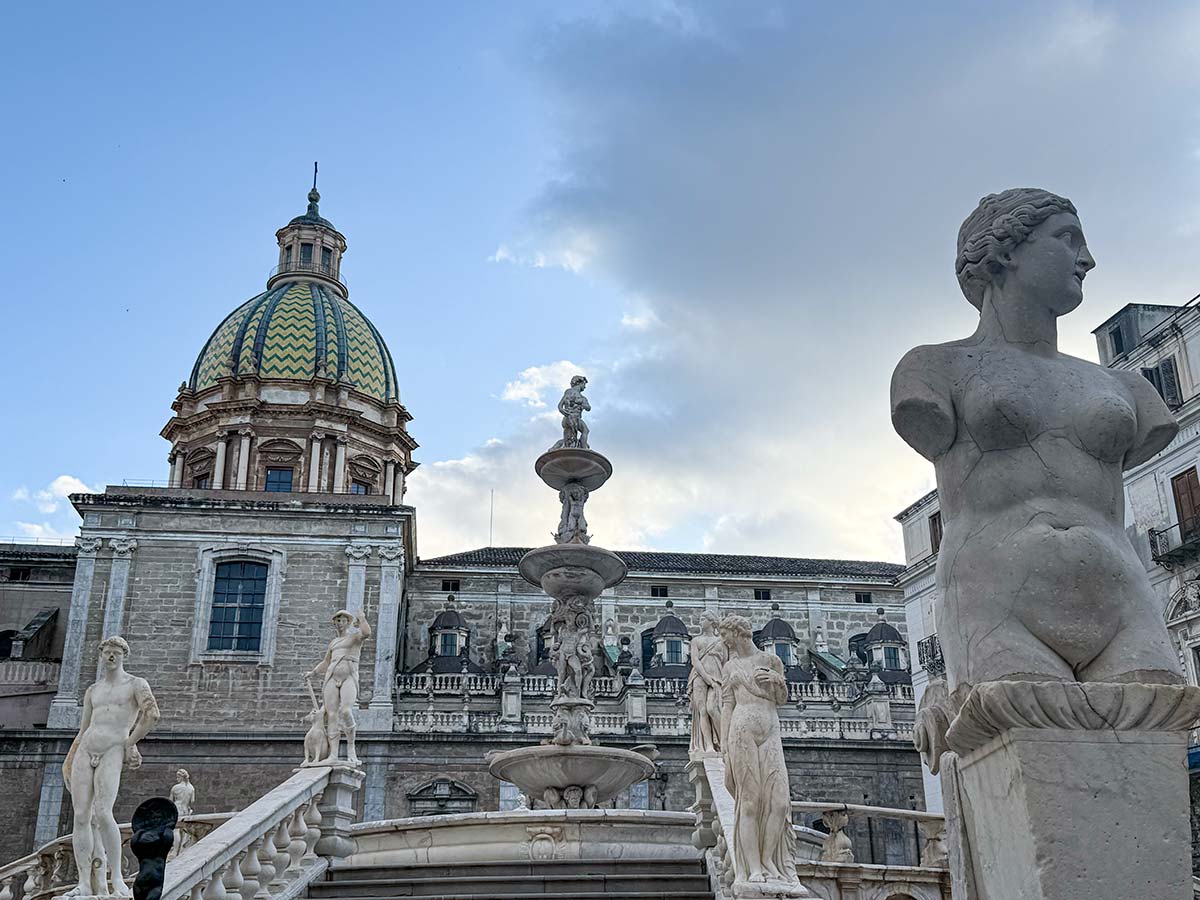
It arrived in 644 numbered pieces, transported by sea and reassembled in front of the town hall, today known as Palazzo delle Aquile.
The nude statues decorating it—nymphs, fauns, sirens, and deities—scandalized locals at the time.
The nuns of the nearby Santa Caterina convent gave it the nickname “Fountain of Shame.”
Today it’s one of the most photographed spots in Palermo.
In the past, capital sentences were read aloud to the crowd here by the Executioner of Sicily.
Palermo Cathedral
After the Fountain of Shame, we took a 20-minute detour to reach Palermo Cathedral.
The kids were tired, so we mainly admired it from the outside and stepped inside only briefly.
The interior is solemn, but after visiting the Santa Caterina complex it felt slightly less impressive.
The façade, however, is worth the detour on its own.
It blends Arab-Norman, Gothic, and Baroque architecture, with interlaced arches, pointed spires, and two towers framing the entrance.
A unique feature is the Gothic-Catalan portico connecting the cathedral to the archbishop’s palace.
Inside—especially if you’re traveling with kids—look for the meridian line on the floor of the central nave.
It’s more than 20 meters long and decorated with zodiac signs. It’s not just decorative but a real scientific instrument. The meridian was created in 1801 by astronomer Giuseppe Piazzi.
A small hole called a gnomon is hidden high in the dome of the Chapel of San Francesco di Paola.
Every day at solar noon, a ray of light hits the meridian line and marks the day of the year.
It was used to calculate equinoxes and solstices, essential for the liturgical calendar.
Today it’s a subtle detail that’s easy to miss—but fascinating if you look for it.
If you have more time and aren’t traveling with very young kids, it’s worth climbing to the cathedral rooftops.
The route includes the Royal Tombs, the Crypt, and the Treasury, offering wide views of Palermo’s domes, bell towers, and the sea.
Teatro Massimo: Palermo’s Grand Stage
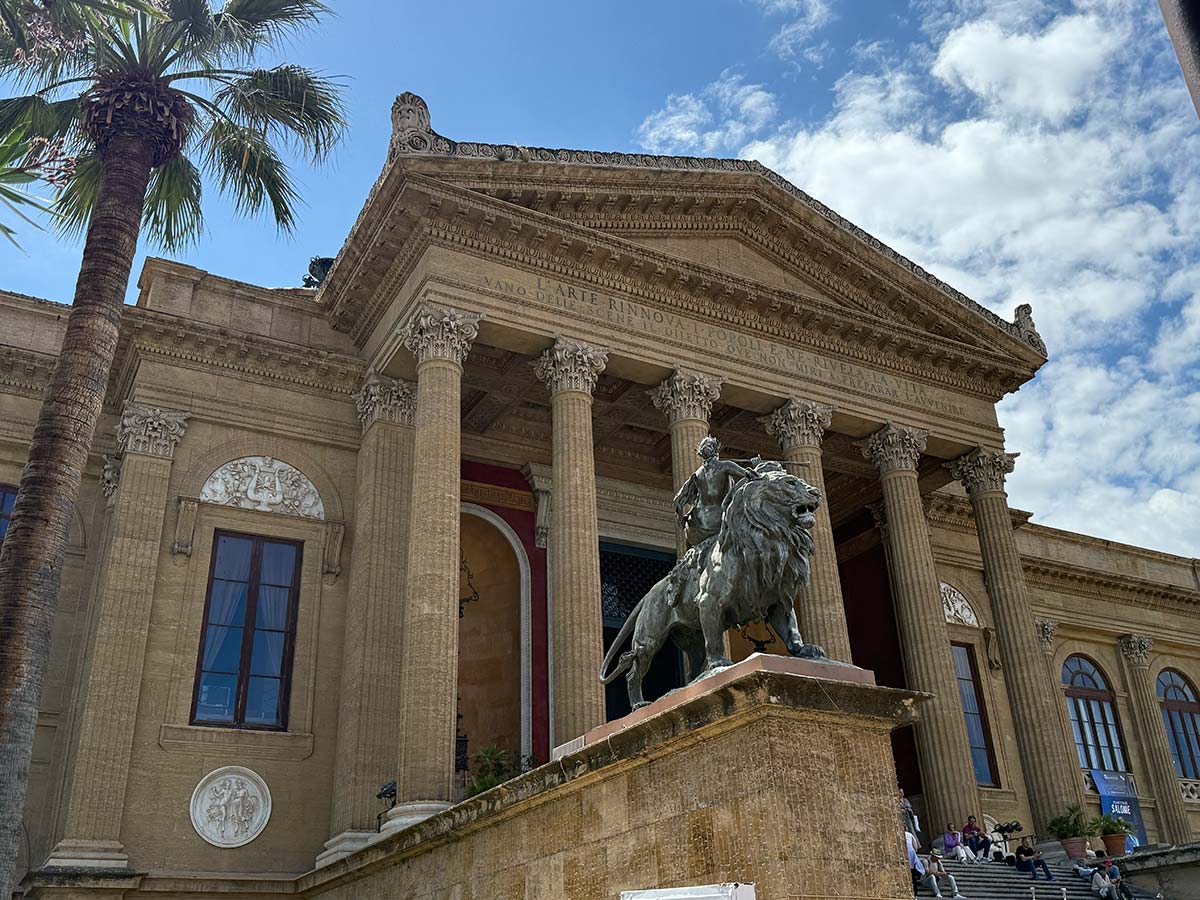
We returned to Via Maqueda and soon found ourselves in front of Teatro Massimo.
We only saw it from the outside—but it’s impossible not to stop.
With its neoclassical architecture, Corinthian columns, and grand staircase, Teatro Massimo is the largest opera house in Italy and the third largest in Europe.
It’s one of the symbols of Palermo’s elegant and cultured side.
Standing in front of the theater, you can still imagine the atmosphere of the past, when audiences arrived in carriages for the opening nights.
If you have more time, you can visit with guided tours every day from 9:30 a.m. to 5:30 p.m.. The ticket costs €10.
Alternatively, you can attend performances or open rehearsals by booking in advance.
Dinner and Rest in Palermo
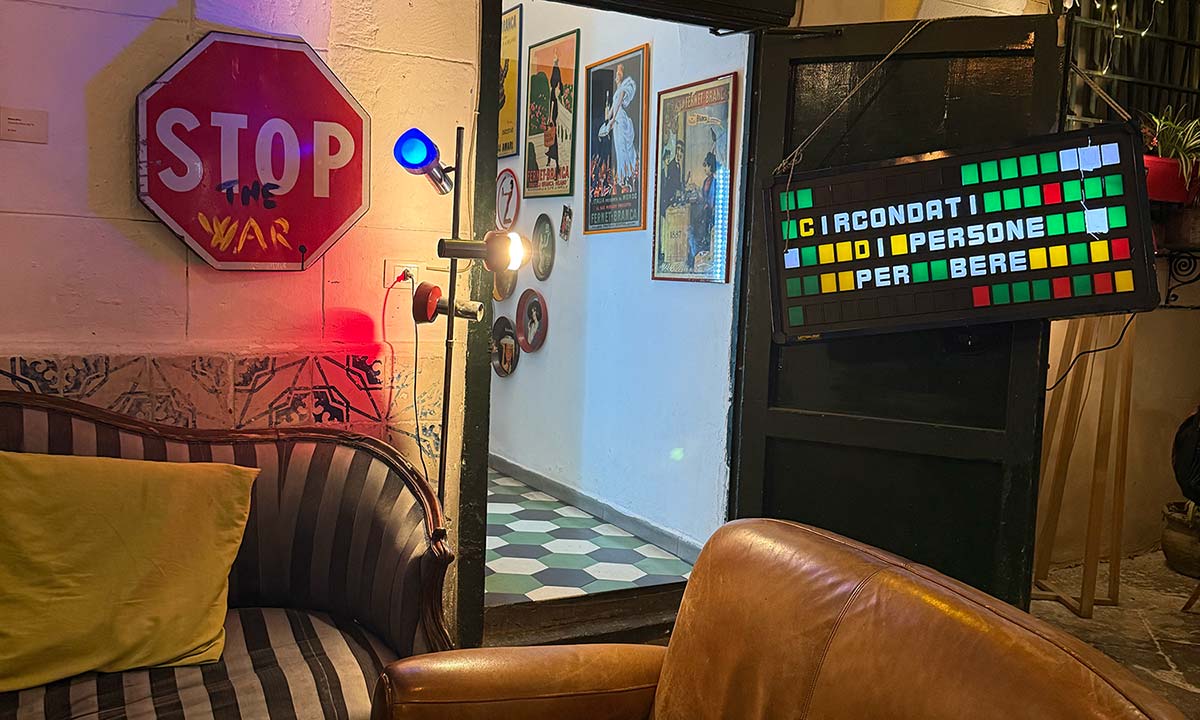
After a long day, we took a short break at the hotel: a quick shower, some rest, and then dinner.
We went to Locale, following a friend’s recommendation.
The atmosphere was elegant but relaxed, and the cuisine offered Sicilian classics with a contemporary twist.
Then it was time for bed.
The kids collapsed. So did we—but happily.
Piazza San Domenico
The morning in Palermo begins slowly.
The night before we bought milk and cookies from Panificio Puccio, a true institution in the city (direction here).
We enjoyed a generous breakfast with reginelle, sesame cookies, Algerian biscuits, and almond-paste sweets.
After breakfast, we set out for our Palermo morning.
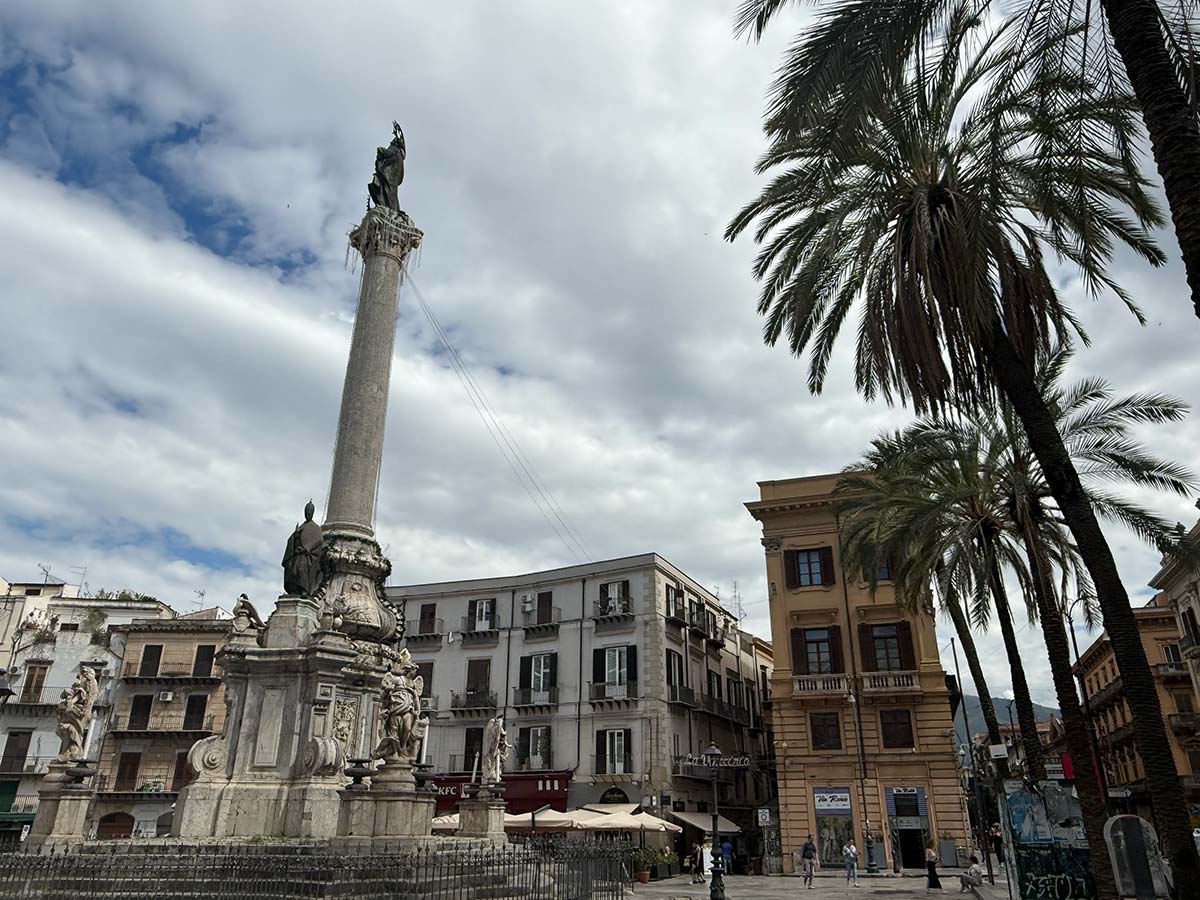
The first stop was Piazza San Domenico, dominated by the large baroque church of the same name.
It’s often called the Pantheon of Palermo, because many notable Sicilian figures are buried here, including Giovanni Falcone.
La Vucciria: The Historic Market
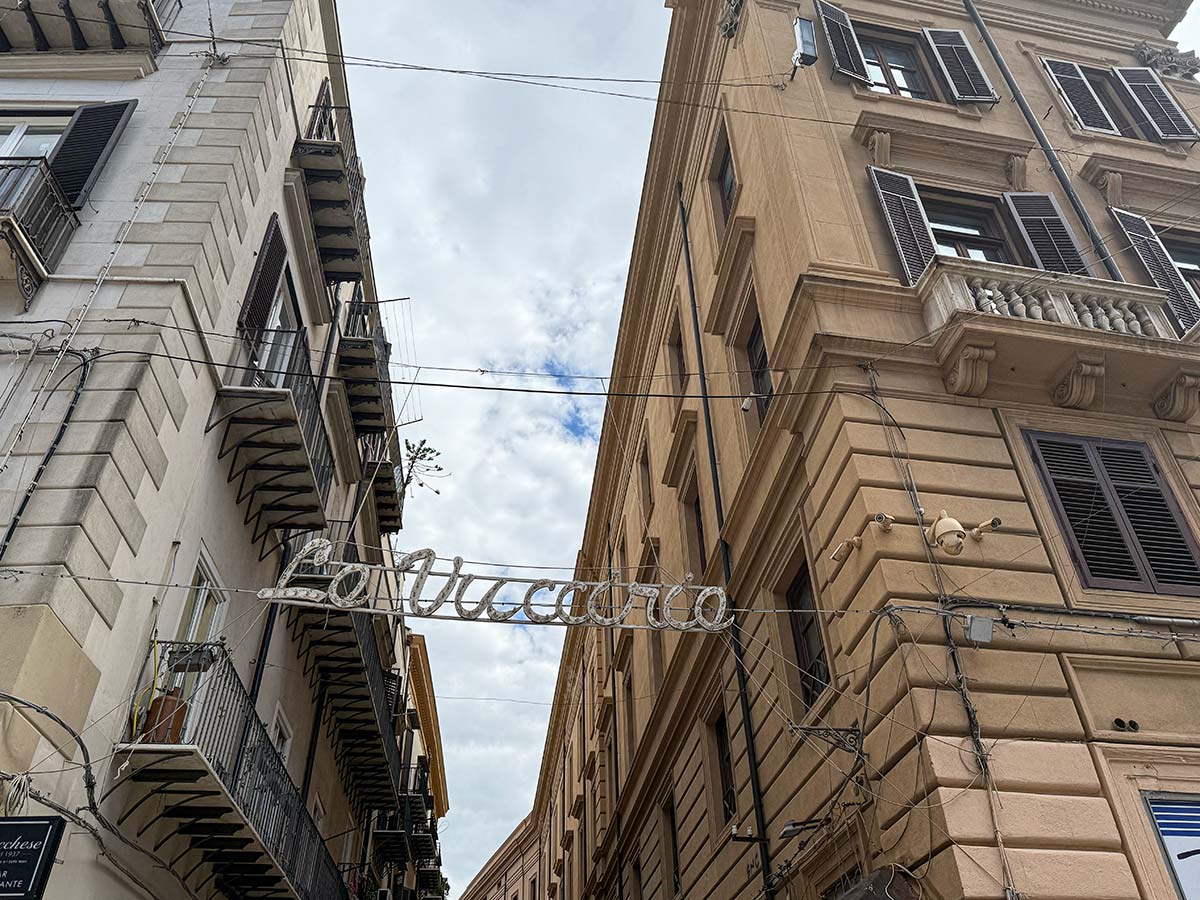
From Piazza San Domenico we walked toward La Vucciria.
Many guides about what to see in Palermo in one day consider it a must-visit stop.
We found a historic market still full of stories, smells, and colors—but also a bit faded.
Murals, empty stalls, and voices tell the story of an authentic Palermo that continues to change.
Nearby we especially liked Via Paolo Paternostro, with small artisan shops selling paper goods, jewelry, and ceramics.
Piazza Marina
Just a few steps away lies Piazza Marina, wide and airy, shaded by the largest Ficus magnolioides trees in Europe.
It’s the perfect pause during a walking itinerary: some shade and space to slow down.
Here you can feel the Liberty-style Palermo of the early 20th century, with elegant buildings telling the story of a refined era.
Palermo Botanical Garden
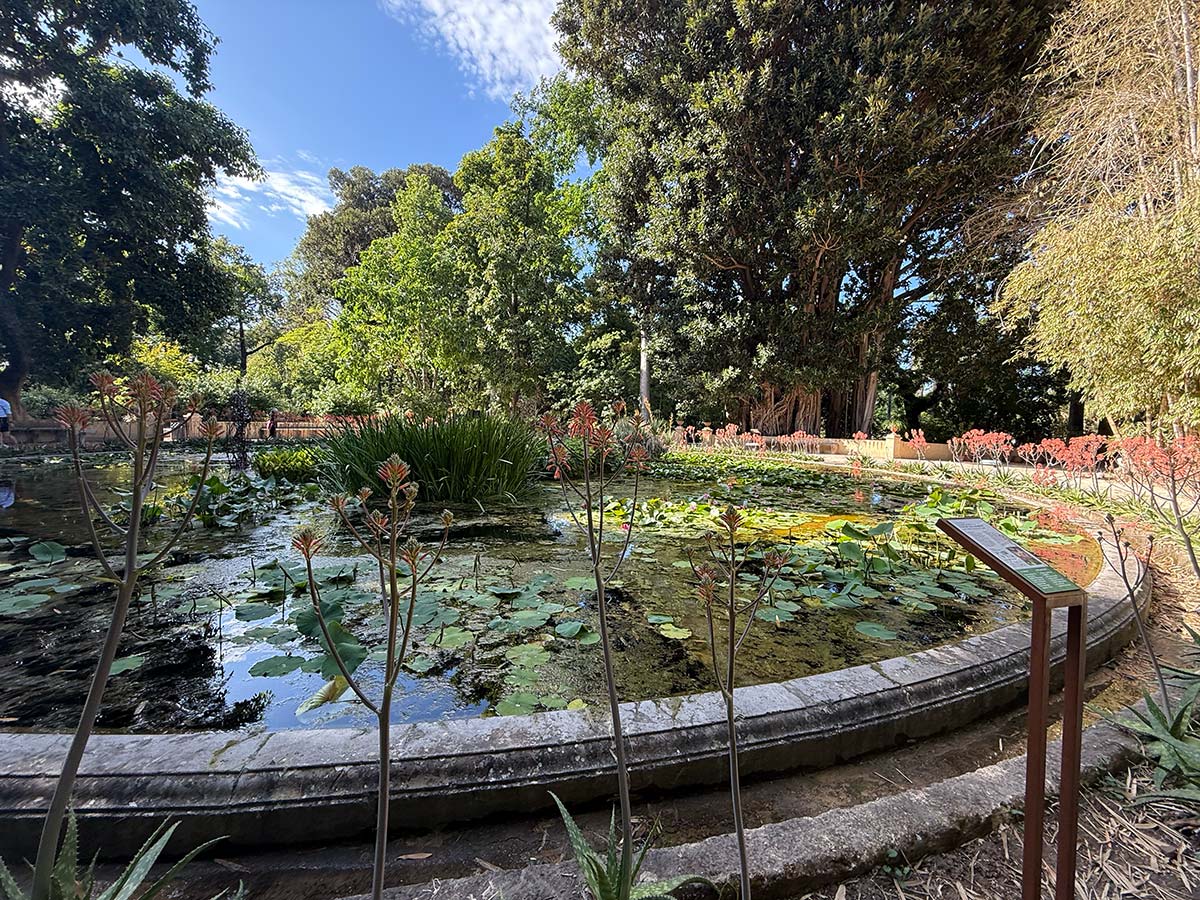
The final stop of our itinerary is the Palermo Botanical Garden, a green and refreshing refuge—perfect for ending a long day in the city.
Kids can run among historic greenhouses, tropical plants, ponds, and giant roots.
Founded in 1789, it’s one of the most important scientific gardens in Europe.
Don’t miss the bookshop as well.
Three things to see in the Palermo Botanical Garden
- The Palm Avenue
Right after entering, you walk along a large central avenue lined with more than 80 palm species from around the world.
One of them is the Washingtonia filifera, which first bloomed in Palermo.
2. The Reed Bed and the Aquarium
The Aquarium is a structure with three concentric circular basins containing aquatic plants.
Nearby, the reed bed creates an exotic atmosphere with tall reeds and marsh vegetation.
3. The Giant Ficus
At the center of the garden stands the monumental Ficus macrophylla, introduced in 1845.
Its aerial roots form new trunks and create a true natural architecture.
Book the ticket here
A Ride on the City Sightseeing Bus
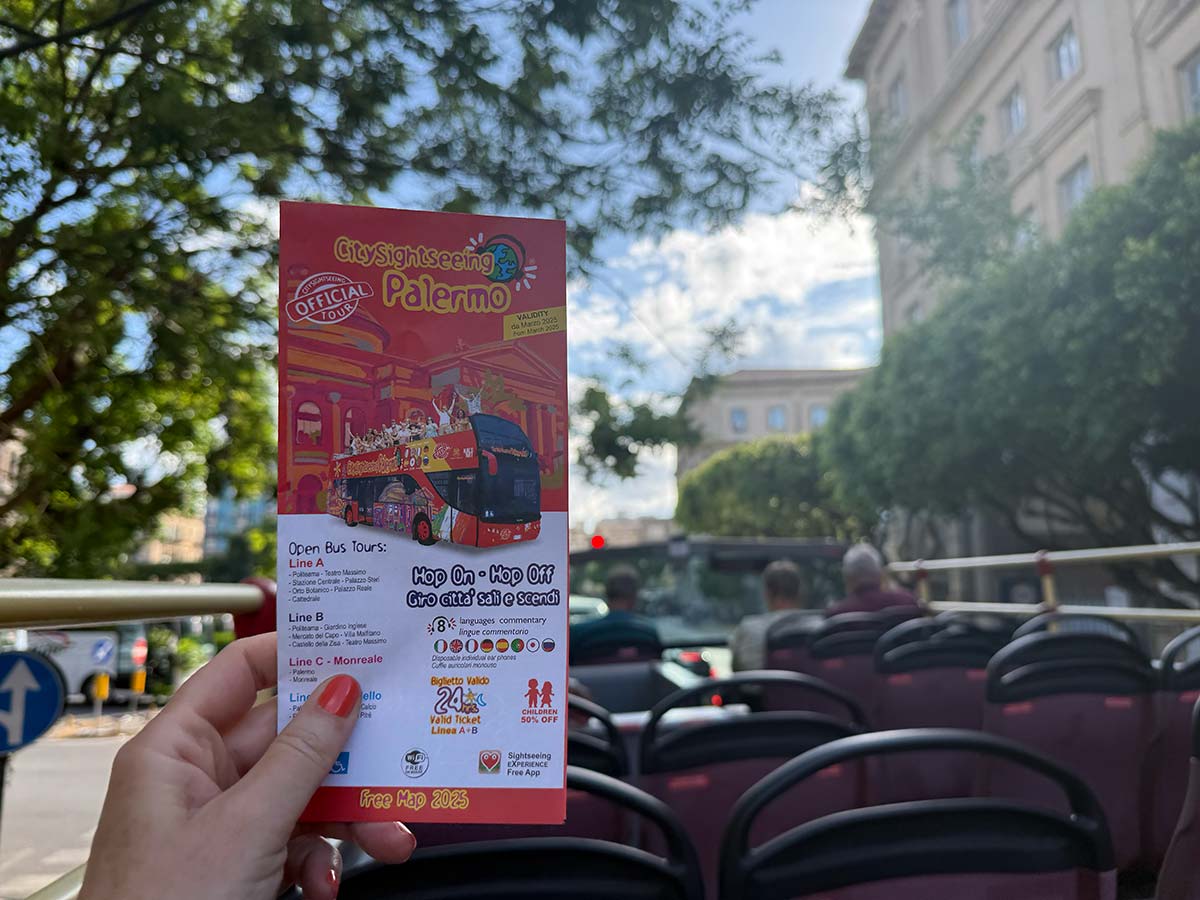
In front of the Botanical Garden we couldn’t resist the classic open-top sightseeing bus.
With limited time, it’s an easy way to get an overview of the city.
The bus route passes many of the main landmarks of the historic center, allowing you to revisit from above the places you explored on foot.
Main stops include:
- Teatro Politeama – tour starting point
- Teatro Massimo
- Quattro Canti (Piazza Vigliena)
- Palermo Cathedral
- Palazzo dei Normanni and Cappella Palatina
- Ballarò Market
- Central Station
- Botanical Garden
- Piazza Marina
- Palazzo Steri
It was our last panoramic ride before saying goodbye to Palermo.
What to See in Palermo in One Day: The Google Map
In 24 hours, you can’t see all of Palermo. But you can start falling in love with it.
What you just read is our version of what to see in Palermo in one day: a mix of walks, markets, churches, squares, and unforgettable food.
We fell in love not only with the city, but also with its people, colors, and aromas—the sea, the fish, the sesame, the flowers.
Spending one night in the city allowed us to experience Palermo at a slower pace and see much more.
Below you’ll find the Google Map of our walking itinerary, including all the stops mentioned in this article.
Exploring Western Sicily from Palermo
Palermo is also an excellent starting point for exploring Western Sicily.
From here you can easily reach:
- Monreale
- Mondello
- Cefalù
- The salt flats of Trapani
- Segesta
- The Zingaro Nature Reserve
A new adventure can begin right here—perhaps with a half-day guided tour.
To explore Western Sicily freely, the best option is renting a car directly at Palermo Airport.
We usually rely on DiscoverCars, which compares offers from major rental companies.
Search for the best deal and start your trip worry-free.